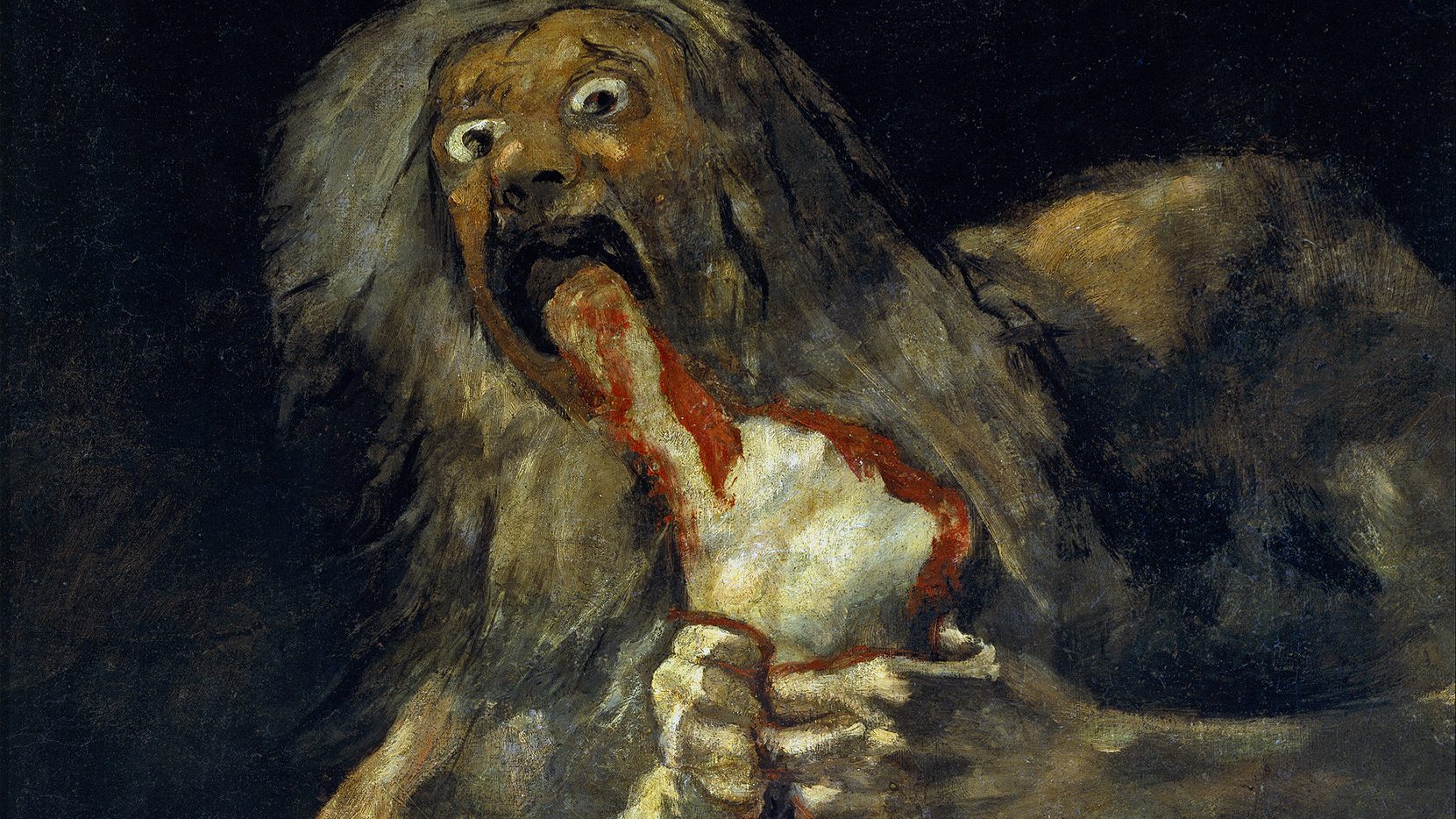
‘Crisis’ is the expression of the contradiction between the promise of capital and its historical reality.
From 1.9.2024 until 1.9.2026, I will be working on a postdoc project funded by the Carlsberg Foundation and based at Bologna University, Italy. The project investigates the notion of crisis as a historico-philosophical category in early political economy, combining Reinhart Koselleck’s historiography with Marxist theories of the transformation of historical time under capitalism. The critical aim of the project is to contextualize historically the politicized production of crisis narratives in contemporary political and economic discourse. Below you will find the project presentation.
The Order of Crisis Time:
A Temporal Revolution of Capitalism
Our recent history appears as a seemingly endless series of crises: The financial crisis, the Covid pandemic, the wars in Eastern Europe and the Middle East, and as a backdrop to them all the steadily escalating climate crisis. Our time has been diagnosed as a ‘universal crisis’,[1] and political philosophers have analyzed this crisis moment as a new mode of political rule.[2] But how has our time come to be viewed as a never-ending crisis? And how does the notion of ‘crisis time’ relate to societal changes in a longer historical perspective? This project investigates how, paradoxically, capitalism’s promise of progress and predictability has transformed into an experience of modernity as crisis time.
The concept of ‘crisis’ itself remains notoriously underdeveloped and scholarship on the crisis concept as a notion of time generally refers back to a single source: the conceptual history of Reinhart Koselleck as the ‘authoritative historiography’.[3] He argued that the concept of crisis, while of medical origin, from the late 18th century onwards migrated into political-utopian discourse and became a vehicle for the historicization of modern time.[4] Recently, however, criticism has been raised against Koselleck for focusing too narrowly on political-revolutionary discourse, largely ignoring economics.[5] This critique can be extended to those accounts relying on his historiography.
On the other hand, within Marxist literature and historical accounts of time under capitalism there has long been an interest in the way time is restructured during the transition towards capitalism in order to discipline work and plan future production.[6] Such interpretations generally emphasize the normalization, standardization, and homogenization of time as a prerequisite for capitalist production. The present project seeks to update Koselleck’s historiography with insights on temporality from historical accounts of capitalism in order to account for the ideological implications of crisis narratives in contemporary political discourse.
The project asks how modern time came to be experienced as a perpetual crisis while simultaneously being reorganized according to capitalist production’s demand for calculability and predictability? It hypothesizes that the narrative of modernity as a cycle of crisis emerges out of attempts to resolve the contradiction between the expectation of a normal course in history and the experience of the abnormal. This contradiction is mirrored in the debates around economic instability and the cyclical nature of capitalist accumulation in the works of British economists from around 1800. Whereas Adam Smith in The Wealth of Nations (1776) could write of self-interest as a natural balancing tendency in the economy, later authors such as Thomas Malthus, Jean-Baptiste Say, and David Ricardo grappled with reconciling this foundation of liberal economics with concrete experiences of political unrest, famine, and economic volatility.[7] They sought to systematize these inconsistencies in the form of economic crisis tendencies and counter-tendencies.[8] I analyze these theories as attempts at ordering historical time and as such, they should be understood as intellectual representations of capitalist temporality, i. e. an economic foundation for what Koselleck has characterized as modern crisis time – a temporality still dominating contemporary political debates.
References
[1] George Edmondson and Klaus Mladek, eds., Sovereignty in Ruins: A Politics of Crisis (Duke University Press, 2017).
[2] Giorgio Agamben and Dirk Schümer, ‘Die endlose Krise ist ein Machtinstrument’, trans. Dirk Schümer, Frankfurter Allgemeine Zeitung, 24 May 2013, http://www.faz.net/-hnr-79ct4; Edmondson and Mladek, Sovereignty in Ruins: A Politics of Crisis; Andrew Simon Gilbert, The Crisis Paradigm : Description and Prescription in Social and Political Theory (Palgrave MacMillan, 2019); Dario Gentili, The Age of Precarity : Endless Crisis as an Art of Government (Verso, 2021).
[3] Janet Roitman, Anti-Crisis (Duke University Press, 2014), 7.
[4] Reinhart Koselleck, Kritik und Krise. Eine Studie zur Pathogenese der bürgerlichen Welt (1959; repr. Suhrkamp, 1973); Reinhart Koselleck, ‘Krise’, in Geschichtliche Grundbegriffe. Historisches Lexikon zur politisch-sozialen Sprache in Deutschland, ed. Otto Brunner, Werner Conze, and Reinhart Koselleck, vol. 3 (Stuttgart: Klett-Cotta, 1982), 617–50; Reinhart Koselleck, ‘Die Verzeitlichung der Utopie’, in Zeitschichten. Studien zur Historik, by Reinhart Koselleck (1982; repr. Suhrkamp, 2003); Reinhart Koselleck, ‘Einige Fragen an die Begriffsgeschichte von “Krise”’, in Begriffsgeschichten. Studien zur Semantik und Pragmatik der politischen und sozialen Sprache (1985; repr Suhrkamp, 2006), 203–17.
[5] Vanessa Ogle, ‘Time, Temporality and the History of Capitalism’, Past & Present 243, no. 1 (2019): 312–27.
[6] Jacques Le Goff, Time, Work & Culture in the Middle Ages (University of Chicago Press, 1980); E. P. Thompson, ‘Time, Work-Discipline, and Industrial Capitalism’, Past & Present, no. 38 (1967): 56–97; Moishe Postone, Time, Labor, and Social Domination: A Reinterpretation of Marx’s Critical Theory (Cambridge University Press, 1993); Jonathan Martineau, Time, Capitalism and Alienation: A Socio-Historical Inquiry into the Making of Modern Time, (Brill, 2015); Massimiliano Tomba, Marx’s Temporalities (Leiden/Boston: Brill, 2013); Stauros Tombazos, Time in Marx: The Categories of Time in Marx’s Capital (Brill, 2014); Harry D. Harootunian, Marx after Marx: History and Time in the Expansion of Capitalism (Columbia University Press, 2015); George Tomlinson, ‘Marx and the Concept of Historical Time’ (PhD thesis, London, Kingston University, 2015); George Tomlinson, ‘Marx, Time, History’, Historical Materialism, 2019, https://www.historicalmaterialism.org/book-review/marx-time-history.
[7] Adam Smith, An Inquiry into the Nature and Causes of the Wealth of Nations, vol. 1-2 (1776; repr. Liberty Classics, 1981); Thomas Malthus, An Essay on the Principle of Population, as It Affects the Future Improvement of Society with Remarks on the Speculations of Mr. Godwin, M. Condorcet, and Other Writers (J. Johnson, in St. Paul’s Church-Yard, 1798); Jean-Baptiste Say, A Treatise on Political Economy; or the Production, Distribution, and Consumption of Wealth, (1803; repr., Grambo & Co., 1850); David Ricardo, On the Principles of Political Economy, and Taxation (1817; repr. Cambridge University Press, 2015); Gerhard Masur, ‘Crisis in History’, in Dictionary of the History of Ideas, ed. Philip P. Wiener, vol. I (Charles Scribner’s Sons, 1973), 589–96.
[8] Daniele Besomi, ‘Tendency To Equilibrium, The Possibility of Crisis, and the History of Business Cycle Theories’, History of Economic Ideas 14, no. 2 (2006): 53–104; Daniele Besomi, ‘The Periodicity of Crises: A Survey of the Literature Before 1850’, Journal of the History of Economic Thought 32, no. 1 (March 2010): 85–132; Jürgen Kocka, ‘Capitalism and Its Critics.’, in The Lifework of a Labor Historian: Essays in Honor of Marcel van Der Linden, ed. Ulbe Bosma and Karin Hofmeester, vol. 35 (Brill, 2018), 71–89.
 Lotte List